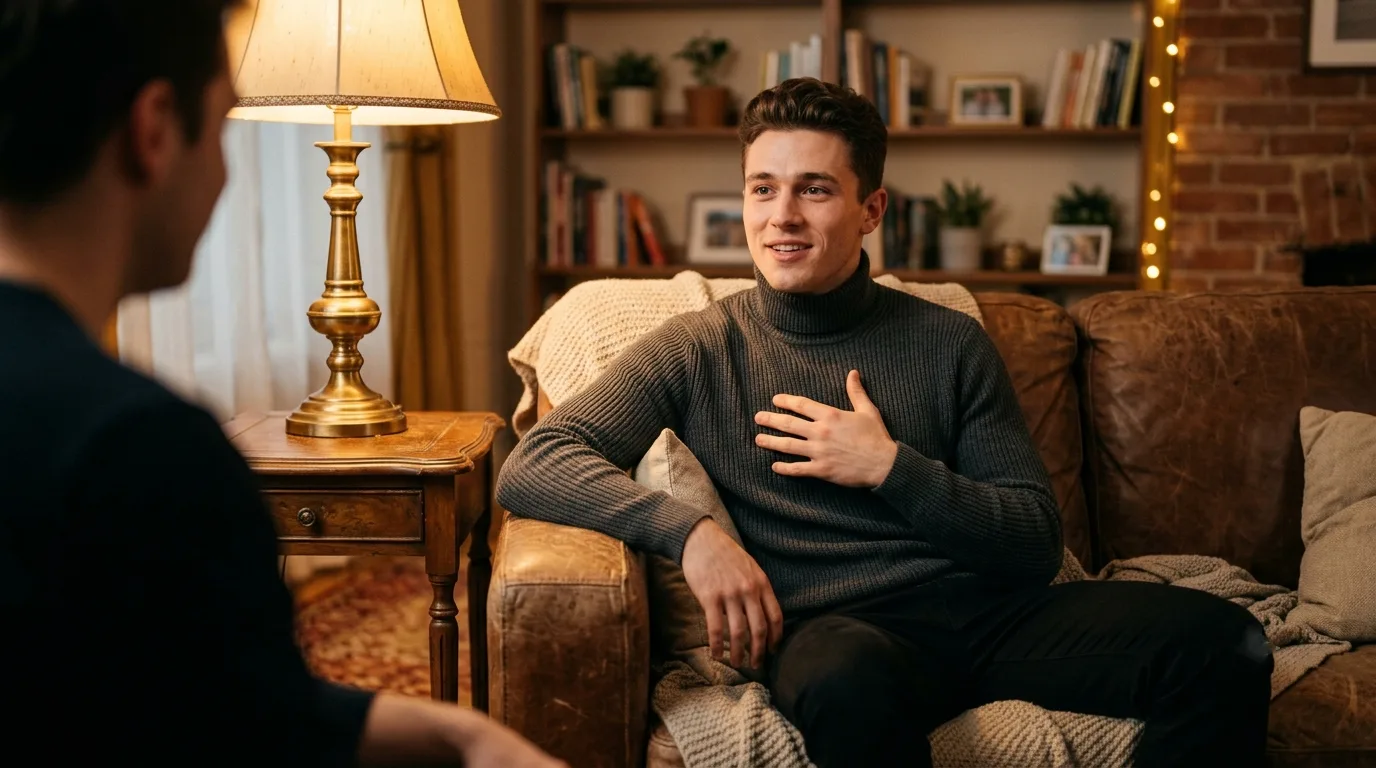
Men and Emotions: Why They Struggle to Open Up, and How to Break Free
This article reveals why men find it harder to express emotions than women, from societal pressure and lack of emotional skills to biological differences. It also explores the painful consequences of emotional suppression and offers actionable steps to break this cycle, helping you build deeper relationships and improve your mental health.
Man, I’m going to ask you a straight-up question: when was the last time you actually talked about your feelings with someone?
Not when you said “I’m fine” when you weren’t. Not when you cracked a joke to dodge talking about what was really going on inside. I’m asking about the last time you truly opened up, genuinely shared what you were feeling, and really let someone see the real you.
If you’re like most men, the answer might be “never” or “I don’t remember.”
And that’s not your fault. You were taught to do that. You were taught that strong men don’t have emotions. You were taught that showing feelings is a sign of weakness. You were taught to “man up” and “toughen up.”
But I’m going to tell you a harsh truth: suppressing your emotions doesn’t make you stronger. It’s killing you day by day.
And it’s time you understood why.
“Men don’t have fewer emotions than women. They’re just taught to hide them better. And that hiding, though it looks like strength, is actually a wound that’s bleeding out.”
1️⃣ The Harsh Truth: Men Feel Emotions Just as Intensely as Women
Let’s start with a basic fact: men feel emotions just like women do. They love, they hurt, they fear, they grieve, and they feel lonely with the same intensity.
But there’s one big difference: the way they express those emotions.
Women are often allowed to express their feelings openly. They can cry, they can share, they can talk about what they’re going through. Society accepts that. It’s even encouraged.
Men, though? Not so much. They’re expected to control their emotions. They’re expected to be strong, to be tough, and to never let anyone see them falter.
But here’s the key: when women are depressed, they usually show sadness or express their feelings. When men are depressed, they often show signs of anger, irritability, or aggression.
Men aren’t less emotional. They just express it differently. And that difference is leaving them misunderstood, isolated, and ultimately, destroyed.
"When a man is angry, it might be sadness trying to break free. When a man is silent, it might be pain trying to hide. And when a man says 'I'm fine,' that is often his biggest lie."
2️⃣ Three Main Reasons Why Men Struggle to Express Emotions
Experts have identified three main reasons why men are reluctant or don't know how to express their emotions. Let's break down each reason.
2.1. Social Pressure, The Trap of "Being a Man"
The phrase "man up!" isn't just a saying. It's a verdict.
From a young age, boys are taught that they must be tough, must be emotionless, and must never show their feelings. They are taught that crying is weak. That being afraid is unmanly. That talking about emotions is taboo.
Research conducted by the men's health charity Movember shows that nearly 1 in 3 men feel pressure to appear masculine or have a masculine personality. Young men aged 18-34 experience this at an even higher rate (47%).
This creates an emotional "trap." Men learn to turn their backs on their emotions, on their fathers, on their own wounds, and gradually turn to work, money, success, sex, substances, and countless other forms of distraction. Instead of facing their emotions, they bury them under a layer of simmering depression, which shows up as emotional numbness, listlessness, apathy, lack of motivation, and a bitter outlook on life.
A real-life example:
Imagine you're going through a difficult time. You feel sad, anxious, and lonely. But instead of telling someone, you keep it to yourself. You're afraid that if you admit you're struggling, you'll be seen as weak.
You work more. You drink more. You chase temporary pleasures. But you never address the real problem. And it only gets worse.
2.2. Not Knowing How to Express Yourself, When You Were Never Taught
No one explains to men how to express themselves. While women can openly show their pain, men tend to hide their pain and put on a stern face.
This leads to a phenomenon called "normative male alexithymia," a term that refers to many grown men having difficulty identifying their own emotions.
When a boy is born, he has the same capacity to feel and express emotions as a girl, but society gradually strips away that connection. Boys grow up with a sense of loss when it comes to connection, forced to detach from their emotions, to drift further from their mother's embrace in order to become a "real man."
They don't know how to name their emotions. They don't know how to process them. They only know how to suppress them.
A real-life example:
You're feeling something. You're not sure what it is. You might be feeling anger, or you might be feeling sadness, or you might be feeling fear. But you don't know how to tell them apart. You only know that you feel "not okay."
And because you don't know how to name it, you don't know how to deal with it. You simply endure it.
2.3. Brain Structure, Biological Differences
Research shows that the brains of men and women are structured and function differently when processing emotions. Men take longer to assess the facial expressions of others, and they generally find it harder to read emotions than women do.
Additionally, from a biological standpoint, men tend to show higher levels of physiological reactivity when faced with emotional stressors. They can be intensely stimulated by emotion, but they've been socialized to suppress it.
"Men may not talk about their emotions, but their bodies do. Every suppressed emotion is a crack in the wall. And one day, that wall will collapse."
3️⃣ The Consequences of Suppressing Emotions, The Price You Pay
When you suppress your emotions, you're not just hiding them. You're creating a burden that your body and mind will have to carry.
3.1. Mental Health Gets Worn Down
Research shows that men suppress their emotions more than women do. And this suppression is linked to symptoms of depression, especially in men.
Masculine norms like emotional control, extreme self-reliance, prioritizing work, and the pressure to win are associated with difficulty identifying and describing emotions. These difficulties are then linked to poorer emotional regulation, which in turn leads to higher levels of anxiety and depression.
Statistics show that over 30% of men will experience depression at some point in their lives, and about 9% of men report feeling down or anxious on a daily basis.
3.2. Physical Health Is Affected
Suppressing your emotions doesn't just affect your mind. It also affects your body. Men with a history of chronic emotional suppression show disrupted cortisol fluctuations and increased systemic inflammation, both established biomarkers of illness and mortality.
Emotional suppression can cause anxiety, depression, and stress-related disorders. Over the long term, it can lead to alcohol and substance abuse, and even suicide.
3.3. Broken Relationships
When you can't express your emotions, you can't connect with others. You may have plenty of people around you, but you won't have deep connections.
Alexithymia and other forms of restricted emotional expression often negatively impact relationships. Men who suppress their emotions are more likely to fear intimacy and struggle to relate to their partner's emotional expressions.
The women beside them see them as unfeeling, cold, and distant. And that, no matter how painful it is, usually isn't the truth. It's just a lack of understanding.
"When you can't talk about your feelings, you're building a wall between yourself and the people you love. And that wall, in the end, will leave you lonely."
4️⃣ How to Break the Cycle of Suppression: A Step-by-Step Guide
It's time for a change. Not just because you deserve to be happy, but because the people who love you also deserve to connect with the real you.
4.1. Acknowledge That You Have Emotions
The first step is acknowledging that you have emotions. You're not a stone wall. You're a human being. And human beings have emotions.
Tell yourself: "I have emotions. And that's normal."
4.2. Learn to Identify Your Emotions
Name your emotions. When you feel "off," ask yourself: "What am I feeling? Am I sad? Am I angry? Am I scared?"
Naming your emotions helps you identify and process them. And that's the first step toward releasing them.
4.3. Find Someone You Trust
You don't have to do this alone. Find someone you trust. Someone you can talk to without fear of judgment.
Start with something small. Share a small emotion. And then, slowly, open up more.
4.4. Practice Vulnerability
Men can learn to listen to and recover their emotions through self-awareness and a trusted companion.
Allow yourself to be vulnerable. Allow yourself to be seen. Allow yourself to connect.
4.5. Seeking Professional Support
If you feel overwhelmed, don't hesitate to seek professional support. Approaches like cognitive behavioral therapy, acceptance and commitment therapy, and mindfulness-based interventions can help you learn how to regulate your emotions.
4.6. Remember That Emotions Are Not Weakness
Emotions are not weakness. They are a part of who you are. And when you can express them in a healthy way, you are showing strength, not weakness.
"Emotions are not the enemy. They are the teachers. And when you learn to listen to them, you will learn to understand yourself."
Checklist: 6 Steps to Break the Cycle of Suppression
- Acknowledge: You have emotions. And that is normal.
- Identify: Put a name to your emotions.
- Share: Find someone you trust to talk to.
- Practice: Allow yourself to be vulnerable.
- Seek support: Don't hesitate to reach out for professional help.
- Remember: Emotions are not weakness. They are a part of who you are.
5️⃣ Sample Messages
"I realize I've been suppressing my emotions for too long. I was taught that was the way to be strong. But I realize that was just the way to be alone."
"I'm not okay. I don't know how to say it, but I need someone to talk to. Can you listen to me?"
"I'm feeling something. I'm not sure what it is. But I know I can't keep suppressing it."
"I'm committed to learning how to express my emotions. I'm committed to not letting fear stop me from connecting with the people I love."
Conclusion: Break the Silence
My friend, you were taught that silence is strength. You were taught that hiding your feelings is the way to survive. You were taught that men don't cry, don't feel fear, and don't need anyone.
But that is a lie.
That silence is not strength. It is a prison. And you have been living in it for far too long.
Break the silence. Talk about your feelings. Allow yourself to be seen. Allow yourself to connect.
Because when you do that, you're not just freeing yourself. You're freeing the people who love you. You're giving them permission to see the real you. And that, my friend, is one of the most powerful things you can do.
Are you ready to break the silence?
Not sure which line fits your situation?
Upload your chat or paste the message — Cupid Mate gives you 3 replies in 5 seconds.
Add a few details about her — the AI matches your real vibe instead of writing generic lines. Optional.
You can skip this — the last message is answered by default.
What you want to say (optional)
Jot down your idea — the AI keeps that direction and rewrites it better and more naturally.
Paste it exactly as it is: shorthand, typos, slang — the AI decodes it for you, no glossary needed.
CupidTeam level
Adults only. No level ever describes bodies or acts explicitly, and none applies pressure.
Reply length (leave empty = AI decides)
Comments
Sign in to join the conversation 💌
A Gmail or iCloud address is enough — Cupid will remember you next time.
Sign in to commentLoading comments…
Related articles

She posted photos of going out without inviting you: 4 steps to handle silent jealousy
She posted photos of going out without inviting you? Don't rush to text her with blame. This article guides you through 4 steps to handle silent jealousy, keep your position, and t

The 'good enough to try' syndrome: Why you disqualify yourself before you even start
Have you ever seen a 9/10 girl and immediately told yourself: 'What makes me think she'd notice me?' That's the moment you've already lost before the game even begins. This article

How to Be Attractive When You're Not Good-Looking or Rich
You don't need to be handsome or rich to attract women. Learn 5 secrets to boost your inner charm, presence, listening skills, and authenticity, and become irresistible.